
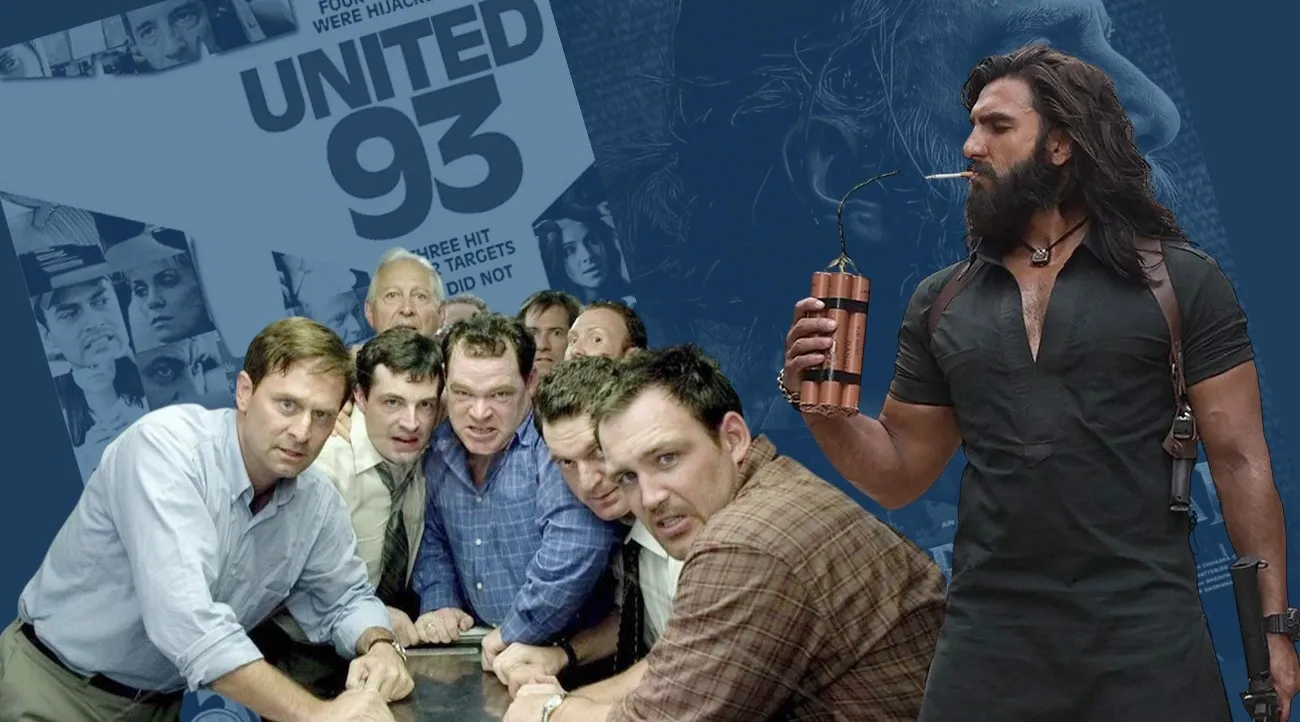
This essay is structured in two parts. The first section compares the film Dhurandhar (Aditya Dhar, 2025) with the American film United 93 (Paul Greengrass, 2006). The second part of the essay details how the movie Dhurandhar obfuscates the identity of Indian Muslims deliberately and villainize them by binding them with Pakistani Muslims.
The events on board the hijacked aircraft United 93, which was intended to crashland on strategically significant buildings by Al Qaeda sympathizers, are fictionalized in United 93. The film honors the bravery and tenacity of American travelers during the turbulent period.
Because they created groundbreaking examples by advancing the official narrative under the pretense of financial success, these two films are regarded as landmarks in their respective industries. United 93 invites comparison due to the numerous similarities it has with Dhurandhar, including its treatment of minorities, the criticisms it has drawn and an aspiration to shape a similar aggressive nationalist consciousness. These parallels will be explored in the subsequent sections.
An initial point of comparison lies in the directors of these films. Both Greengrass and Dhar are established mainstream directors in their respective industries, recognized for producing films that foreground patriotism and national loyalty. Greengrass, known for the Bourne series, and Dhar, with works such as Uri - The Surgical Strike (2019) and Article 370 (as co-writer, 2024) have consistently brought national pride to the forefront of their narratives. The two directors are regarded as successful mainstream filmmakers with notable technical competence. Another significant similarity is the foundational narratives that underpin their films. United 93 draws on the 9/11 Commission Report, while Dhurandhar is informed by the dominant Hindutva narrative. Both parrot the official government versions of the incidents they narrate and clamour for an aggressive intent, without endeavouring to ask difficult questions or examining the larger sociopolitical unfolding. This endorsement of official doctrines often occurs without a comprehensive engagement with the broader socio-political context. Anurag Kashyap’s film Black Friday (2004) may offer a contrast here, which, by weaving together the Bombay blasts, the communal riots, and the Babri Masjid demolition into one narrative whole, shows that these events are interconnected and transcend individual regimes, implicating various actors beyond political parties and alliances. The rise of Al-Qaeda, its connections with the United States, and the strained multicultural fabric of American society are interlinked, just as the ascent of Hindutva in India, communal violence and alleged external influences. The events leading to the Indian Parliament attack can be traced to the release of terrorists following the Kandahar hijacking, which occurred under the same ruling party. The forenamed films, while claiming to be ‘Based on True Events’, purportedly seek to address national trauma and humiliation. However, their claims to authenticity are undermined by selective omissions: Dhurandhar remains silent on the 2007 Samjhauta Express bombing, which has dubious linkages, dismisses suspicions regarding the 2002 Godhra train burning, and sidelines questions about security failures during the 2001 Parliament Attack. Similarly, United 93 omits the context of strained US–Arab relations and the hostile climate faced by Muslims in America, instead presenting the United States as an idealized, progressive society.

Lauren Rebecca McKee, in her article 'How United 93 Promotes Racism to the American People,' examines why only the story of United 93 was adapted into a commercial film, while the flights that struck the World Trade Center and the Pentagon were not. United 93 constructs a narrative of bravery and resistance, portraying liberal Americans as superior in their struggle against perceived uncivilized invaders. Had another flight been chosen, the opportunity for this narrative of rebuttal might have been lost. A similar dynamic is present in Dhurandhar, where the depiction of Hindus as endangered serves to counter accusations of cowardice and reinforce a narrative of resilience.
The films adopt a docudrama approach (The American film employs a first-person narrative style), incorporating real-life footage to enhance authenticity. Original recorded conversations are included, and in United 93, some real-life individuals make an appearance and reprise their own roles. The cinematography in the film features rapid camera movements, frequent zooms, and occasional visual obstructions, immersing viewers in the depicted events. In either films on-screen textual annotations provide supplementary information, and the use of black-and-white or grainy film stock further contributes to the sense of realism. In both cases, the film becomes synonymous with the event itself.
Another significant aspect is the othering of minority communities, particularly Muslims, in both contexts. American and Hindi films have contributed to heightened Islamophobia through negative portrayals of Muslims. Films such as True Lies (James Cameron, 1994), The Delta Force series, The Siege (Edward Zwick, 1998), The Sum of All Fears (Phil Alden Robinson, 2002), and The Peacemaker (Mimi Leder, 1997) frequently depict Muslims, as terrorists, establishing a problematic standard. Representations often oscillate between the 'Good Muslim' and the 'Bad Muslim,' reinforcing a binary of allegiance. This dichotomy was further legitimized by official rhetoric. In India, a once pluralistic cinematic landscape of the Hindi industry, although far from free of biases and prejudices, has now shifted more ostensibly toward skewed depictions of Muslims in films like The Kashmir Files (Vivek Agnihotri, 2022), The Kerala Story (Sudipto Sen, 2023), and The Taj Story (Tushar Amrish Goel, 2025). United 93 and Dhurandhar intensify public anxiety toward Muslims, with both films misrepresenting Muslim culture, language, and practices.
Both films construct an experience of collective identity. Sheeba K notes in her essay Cinema Terrorism and Political Ideology: An analysis of Subtitles in United 93 that the cursory camerawork and montage techniques used in the movie transform individual characters into a unified national community. Similarly, Dhurandhar portrays the nation as a collective entity affected by violent attacks. In both cases, the audience is positioned as part of a violated collective, compelled to unite in response.
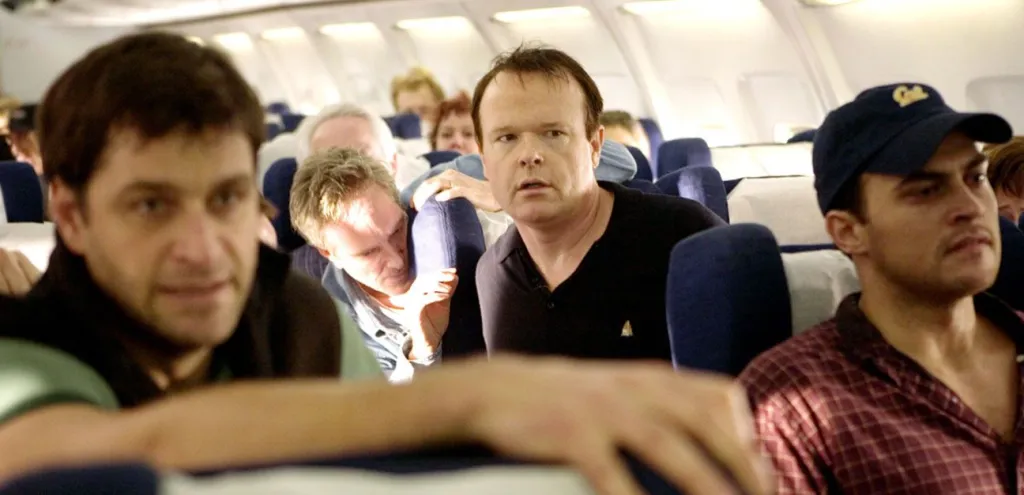
Interspersed through both the films are sequences featuring red and dark screens which underscore and reiterate the violence inflicted upon the nation. Phillip E. Wegner, in his article 'The Dead Are Our Redeemers: Culture, Belief, and United 93,' compares the attacks on America to a fresh wound, noting that the World Trade Center Memorial itself resembles such an injury. Sheeba similarly interprets these cinematic moments as memorials. Attacks on American symbols and significant Indian sites are depicted as wounds that remain open and unhealed. Dhurandhar’s use of a red screen parallels United 93 in this regard. Wegner observes that 'in the initial screenings of United 93, the film concluded with a title card on a black screen that read: “America’s war on terror had begun”.' Both films can thus be interpreted as cinematic lacerations or memorials, designed to evoke and organize dominant emotions in response to perceived pervasive threats.
As previously noted, only the story of United 93 was adapted into a film, and it concludes with a fictionalized ending in which the passengers, having grown weary of victimhood, decide to resist, despite official records disputing their ability to enter the cockpit and subdue the terrorists. Ultimately, the flight crashes, but the narrative frames this as a sacrifice that preserves eminent national institutions. The film suggests that, without timely intervention, the suicide mission could have succeeded. Similarly, Aditya Dhar’s film speculates that the nation was vulnerable to terrorist attacks during previous (Congress-led) regimes, implying that any region could have been targeted. The narrative asserts that the arrival of 'capable' leaders restored national security and prepared the country for retaliation and the reclamation of past glory. Dhurandhar, through characters modeled after figures such as Ajit Doval (National Security Advisor of India since 2014), emphasizes that national security and interests were previously neglected. Both films highlight the perceived incapacity of officials or leaders to prevent the disaster.
The two cinematic works employ the trope of the 'internal enemy.' In United 93, a German passenger attempts to dissuade American passengers from resisting, suggesting that the hijacking is for ransom and that hostages will be released once demands are met. As tensions escalate, the character proclaims, 'Ich Bin Deutsche,' or 'I am German.' Alexander T. Riley, in his book 'Angel Patriots: The Crash of United Flight 93 and the Myth of America,' dismisses this portrayal as 'a remarkable bit of narrative symbolism with no basis whatsoever in fact.' This characterization positions the German as a coward in contrast to the loyal Americans. Dhurandhar similarly posits that the nation's greatest threats are internal, advocating for harsh measures against such elements. This aligns with contemporary narratives in India that label dissenting groups as 'Urban Naxals,' 'Anti-Nationals,' 'Sickulars,' 'Tukde tukde gang,' 'Lutyens’ lobby,' and 'Breaking India forces.' Such tropes serve to alienate and criminalize individuals or groups who challenge state narratives.
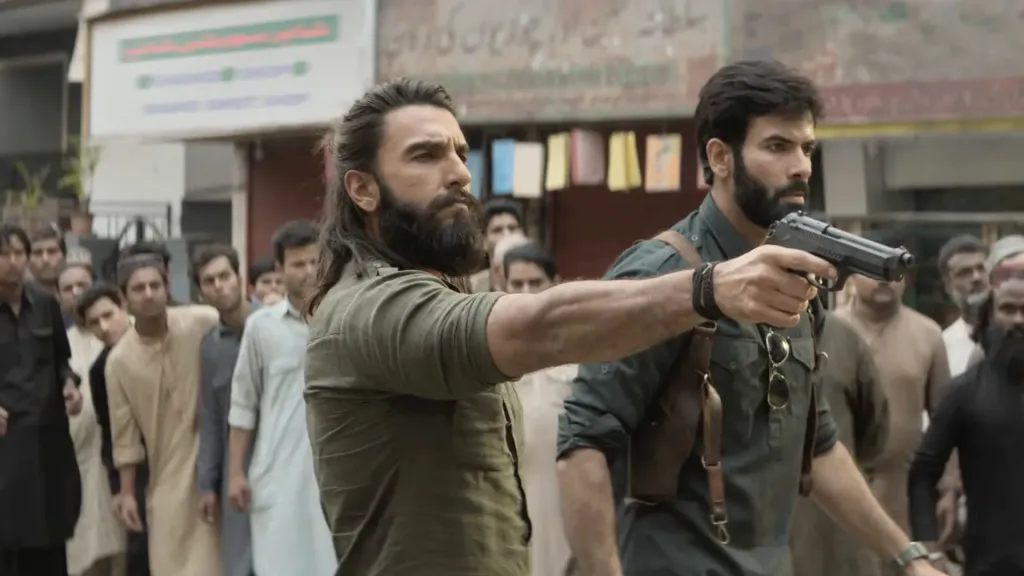
Both films exemplify what Wegner describes as 'mass mediated repetition.' Audiences are invited to (re)view these events through cinematic representation which purports to bring them closer to the 'truth.' By presenting narratives that contradict earlier accounts, the films offer what they claim to be more authentic and reliable versions of events. Both films explicitly call for resistance: the 'war on terror' is openly declared, and the need to seize weapons of mass destruction is emphasized. In Dhurandhar, Ranvir’s Hamza Ali Mazari is depicted as being on a mission to eliminate the nation’s enemies. The films transform innocent victims into aggressors, underscoring the necessity of arming oneself against imminent threats. In this way, the films serve as metaphors for nations that have allegedly experienced humiliation, but are now prepared to retaliate.
If asked whether I would watch the second part of Dhurandhar, my answer would be affirmative. As V. C. Harris notes regarding the 'uneasy pleasure of watching Deshadanam,' Dhurandhar, with its fast-paced editing and expansive shots, offers the pleasure of spectacle. United 93 similarly functions as a thriller, distinguished by technical excellence, close-up shots that foster intimacy with characters, and lighting that evokes the atmosphere of an ordinary day in America. Both films may obscure their underlying intentions beneath the veneer of commercial cinema.
How Dhurandhar chokes with one hand while sniffing the groin with the other?
I was deeply disturbed by one particular scene in Dhurandhar, in which a Pakistani man puts his hands inside Hamza Ali’s (played by Ranvir) pants and enjoys the smell of his hands. What kind of representation does it intend? Does it summon to our memory the character of Alauddin Khilji from the movie Padmaavat (Sanjay Leela Bansali, 2018)? Does the misrepresentation of foreign Muslims fall heavily on the Indian Muslim?
In ‘Dhurandhar’, the Muslim characters are always pictured as violent, perverse, or morally corrupt. The scenes of Muslim men as sexual predators, coded sometimes via homosexuality, serve to heighten fear and disgust. Critics have aptly mentioned the stark lack of any positive Muslim figures. Defenses of such portrayals often argue that the narrative is set outside India, but its psychological impact transcends geographic boundaries. We may see that over and beyond the biases in the storyline, cinema as a holistic audio-visual medium is mobilized to support this narrative. Corey K. Creekmur’s essay “The Sound of the War on Terror” explores how post-9/11 Hollywood employs repetition of sonic cues to dehumanise the enemy. Similarly, Hindi propaganda films utilize Arabic music, the ‘adhaan’, or Middle Eastern soundscapes to signal Muslim characters as suspects before they register
as such. The ‘adhaan’, once an act of culture and religion, is taken up and repackaged as a
warning - a case of what can be referred to as ‘aural orientalism’. Islam has been
narrowed down to a handful of threatening sounds. By employing such an analogy, ‘Dhurandhar’ portrays Muslims as a unified civilizational entity, transcending boundaries and states.
Psychoanalytic film theory also offers insight into another mechanism of alienation. Cinematography enables audiences to unleash unconscious anxieties on screen images. If ‘Jaws’ (Steven Spielberg, 1975) turned social anxieties into shark imagery, contemporary Hindi cinema externalizes national problems onto the Muslim “other.” As Slavoj Žižek discusses, these films present a delusion that if we eliminate an enemy, the systemic contradictions will diminish, thereby distracting from the socio-economic realities
of the world. This Muslim other, who is ‘foreign’ to our land, can easily be identified with a Pakistani counterpart - barbaric, unclean, and dangerous.

It is coincidental that two movies produced by two different industries and with a time gap of about twenty years has such similarities, but given the contexts and the politico - cultural events, the similarity doesn't seem odd. America has been prepared for a war for a long time through action flicks and spy thrillers. Nick Muntean says in his article "It was Just Like a Movie” that the spectators of the 9/11 disaster remarked that it resembled a movie. It was a spectacle that the natives had seen before and now reproduced in broad daylight. Dhurandhar anticipates such a situation where the alleged stigma afflicted on the (Hindu) self has been recompensed. Dhurandhar, through its visual and technical extravaganza, impersonates as a Commercial potboiler but dissimulates sheer propaganda.
BIBLIOGRAPHY
1. Creekmur, Corey K. “The Sound of the War on Terror.” Reframing 9/11: Film, Popular Culture and the ‘War on Terror’, edited by Jeff Birkenstein et al., Continuum, 2010.
2. McKee, L. R. “How United 93 Promotes Racism to the American People.” Peace Review, vol. 29, no. 2, 2017, pp. 239–243. https://doi.org/10.1080/10402659.2017.1308739
3. Muntean, N. “‘It Was Just Like a Movie.’” Journal of Popular Film and Television, vol. 37, no. 2, 2009, pp. 50–59. https://doi.org/10.3200/JPFT.37.2.50-59
4. Riley, Alexander T. Angel Patriots: The Crash of United Flight 93 and the Myth of America. NYU Press, 2015.
5. Sheeba, K. “Cinema, Terrorism and Political Ideology: An Analysis of Subtitles in United 93.” [Offscreen], vol. 28, nos. 8–10, Aug. 2024.
6. The Pervert’s Guide to Ideology. Directed by Sophie Fiennes, performance by Slavoj Žižek, P Guide Ltd., 2012.
7. Harris, V. C. “On the Uneasy Pleasure of Watching Deshadanam.” Deep Focus, vol. 7, no. 1, 1997, pp. 5–7.
8. Wegner, Phillip E. “‘The Dead Are Our Redeemers’: Culture, Belief, and United 93.” American Multiculturalism after 9/11: Transatlantic Perspectives, edited by D. Rubin and J. Verheul, Amsterdam University Press, 2012, pp. 81–92.