

Executive Summary
India’s industry–academia divide is not a single gap. It is a set of mutually reinforcing gaps: a salary gap that pulls talent toward industry, a patent-to-product gap that prevents research from becoming useful technology, a trust gap between companies and universities, and a red-tape gap that makes collaboration slower than the market will tolerate. The problem is not that universities and companies are different. They should be different. Universities protect long-term inquiry, peer review, public reasoning and intellectual independence; industry moves through customers, deadlines, capital discipline and competitive urgency. The policy challenge is to make the boundary permeable without turning universities into contract shops or companies into philanthropic funders of unfocused research.
The quantitative picture is stark. India’s gross expenditure on R&D has remained around 0.6-0.7 percent of GDP, below the global average and far below the R&D intensity of leading innovation economies. Publicly funded research still carries much of India’s scientific burden, while business investment in university-linked research remains thin. Public university pay is anchored to national pay matrices: an entry assistant professor begins around Academic Level 10, while a professor is anchored around Academic Level 14 with a rationalised entry basic pay of Rs. 1,44,200. By contrast, high-demand industry roles in AI, data science, semiconductor design, cybersecurity, product management and biotech may combine base pay with bonuses, equity, consulting income and global mobility. This does not mean all academics are underpaid in absolute terms; it means the opportunity cost of academic careers is highest in fields that are most important to innovation.
The qualitative picture is equally important. Faculty often stay in academia for autonomy, curiosity, prestige, public purpose and the joy of mentoring. Yet many also describe administrative overload, weak research management support, uncertain IP rules, slow procurement and opaque consulting policies. Companies often admire academic talent but complain about timelines, unclear deliverables, slow contracting, publication pressures and technology readiness. Students see industry as faster, better paid and more connected to modern tools. Administrators often become risk-averse because audit, vigilance and procedural compliance punish visible mistakes more than they reward successful commercialisation.
Globally, no single model solves this. The United States built strong technology transfer through the Bayh-Dole framework, university technology transfer offices, venture capital and entrepreneurial culture. Germany’s Fraunhofer model institutionalised applied research between universities and industry. Israel professionalised commercialisation through university-linked companies. Singapore demonstrates state-led research translation; South Korea shows how anchor firms can absorb university research; the United Kingdom has used knowledge-transfer and impact incentives. These systems differ, but all contain three common elements: clearer rules, professional intermediaries and incentives that reward translation without abandoning basic research.
For India, the reform agenda must be institutional rather than rhetorical. More MoUs will not bridge the divide. India needs flexible faculty compensation in high-demand fields, transparent consulting and conflict-of-interest rules, professional technology transfer offices, standard contracts, faster procurement, industry-funded PhD and postdoctoral pathways, translational grants, regional innovation clusters and audit rules that evaluate outcomes rather than only procedures. Public universities need autonomy with accountability; private universities need deeper research capacity and credible doctoral ecosystems. Industry must move beyond campus recruitment and fund long-term research chairs, shared labs, doctoral fellowships and prototype-to-market pathways.
Kerala offers a useful regional case. It has high human development, a large diaspora, a strong education base, digital infrastructure, health and life-science assets, IT parks and an active startup mission. Kerala Startup Mission has been associated with thousands of startups, dozens of incubators and a broad student innovation network. Institutions such as Digital University Kerala, APJ Abdul Kalam Technological University, Maker Village, Technopark, Infopark, Cyberpark, Sree Chitra Tirunal Institute, Rajiv Gandhi Centre for Biotechnology, CSIR-NIIST, IISER Thiruvananthapuram and CUSAT offer a foundation for a knowledge-led economy. Yet Kerala’s challenge is moving from incubation to commercialisation and scale: more technology transfer offices, state-level IP rules, diaspora capital, translational funds, public procurement pathways and sector-specific clusters are needed.
1. Introduction: Why the Divide Matters
Imagine a young AI researcher in Bengaluru, Hyderabad, Kochi or Delhi. One offer is a faculty post: intellectual freedom, doctoral students, a long career in research and teaching, but a salary anchored to institutional rules, grant uncertainty and administrative work. The other offer is from a global capability centre or a product company: higher pay, cloud credits, large datasets, product teams, stock-linked upside and immediate market relevance. The choice is not merely personal. It tells us how a country allocates its most scarce innovation resource: human talent.
Now imagine a different story from a public university lab. A faculty team develops a low-cost medical device, a coastal sensor, a food-processing technology or an AI tool for public health. The prototype works. Students are excited. A startup wants to license it. Then the project enters a maze: who owns the IP, whether the faculty member can hold equity, who signs the non-disclosure agreement, whether procurement rules allow a specialised component, whether the university can accept milestone-based industry funding, and whether an auditor will later question the decision. By the time the file moves, the market may have moved faster.
The industry–academia divide is usually described as a mismatch between “theory” and “practice”. That description is too shallow. The divide is about incentives, time horizons, governance, risk, money, ownership and trust. Universities are rewarded for publications, teaching loads, accreditation compliance and academic reputation. Companies are rewarded for products, margins, speed, customer adoption and defensible IP. A university may view a five-year research programme as normal; a startup may need a validated prototype in five months. A faculty member may see publication as recognition; a company may see premature disclosure as loss of competitive advantage. Neither side is irrational. They are optimising for different systems.
The national cost is high. India produces large numbers of engineers, managers, scientists and PhDs, but the conversion of academic knowledge into patents, products, standards, deep-tech firms and public-interest technologies remains uneven. Elite institutions such as IITs, IISc, IISERs and select research labs show what is possible, but the broader university system remains constrained by funding gaps, faculty shortages, weak research administration and bureaucratic rules. Private universities bring flexibility but vary widely in research depth. Public universities bring credibility and public purpose but are often tied to rigid systems.

2. The Salary Divide: The Talent Market Problem
Salary is not the only reason people choose careers, but it is a powerful signal of what a system values. In public higher education, compensation is structured around national or state pay scales, seniority and formal qualifications. An assistant professor’s entry pay is anchored around Academic Level 10; associate professors and professors move to higher academic levels, with professor-level rationalised entry pay commonly cited at Rs. 1,44,200 basic under the 7th CPC framework. Allowances and institutional variations matter, but the structure remains relatively compressed compared with industry.
Industry salaries are much more dispersed. A routine engineering services role may not dramatically exceed academic compensation after job security and benefits are considered. But high-demand roles in AI, machine learning, cyber security, semiconductor design, product management, quantitative finance, biotech, regulatory science, advanced manufacturing, chip design and climate technology can move far ahead. Compensation may include bonuses, employee stock options, consulting income, performance-linked incentives, international postings and faster promotion. TeamLease’s salary research has reported salary growth across sectors and stronger salary momentum in engineering and technology-linked roles. The opportunity cost of academia is therefore highest exactly where universities need talent most.
Indicative salary and incentive comparison
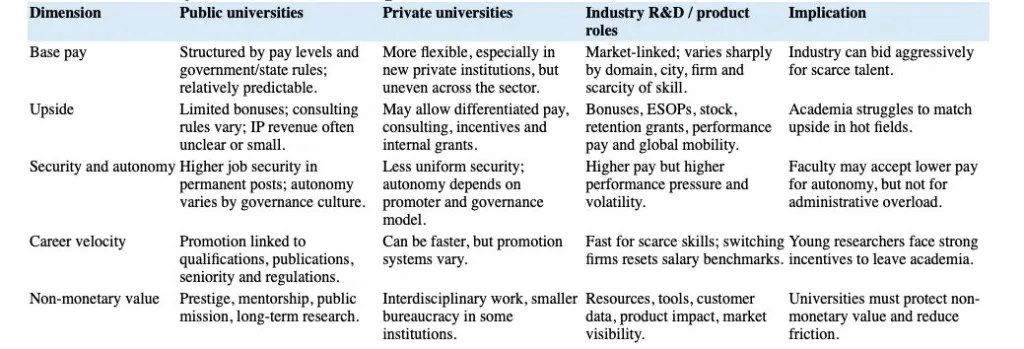
The salary divide has four consequences. First, faculty recruitment becomes difficult in fast-moving fields. Second, doctoral students see academic careers as financially irrational unless they are deeply motivated by research or public service. Third, faculty morale suffers when universities demand world-class output but provide weak staff support, old equipment and slow processes. Fourth, universities become dependent on a small number of intrinsically motivated faculty who carry teaching, grant writing, institution-building and entrepreneurship simultaneously.
Yet a purely salary-centric analysis would be misleading. Many academics do not want industry jobs. They value intellectual independence, reputation, mentorship and the ability to ask questions not yet valued by the market. The question is not whether universities should copy corporate salaries. It is whether India can design academic careers that are financially dignified, administratively enabling and professionally attractive enough to retain exceptional talent in fields central to national development.
Leadership and Faculty Salary Comparison: Academia vs Industry
The salary divide becomes sharper when academic leadership and senior faculty pay are compared with corporate leadership pay. The table below uses statutory public pay bands where they are formally defined, and indicative market ranges where private universities or corporate roles do not disclose compensation consistently. Figures are approximate annualised compensation in Indian rupees and should be read as ranges, not as exact salaries for every institution.
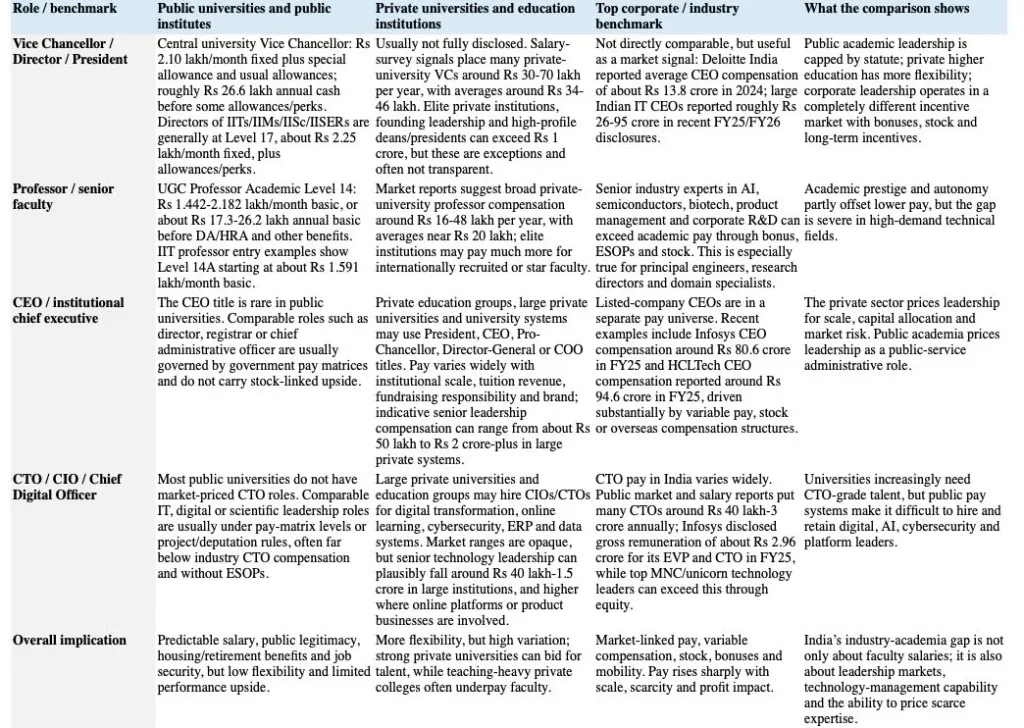
Method note: Public-institution figures refer mainly to basic pay or fixed pay and exclude the full value of allowances, housing, pension/NPS benefits and institutional perks. Corporate figures are total remuneration where disclosed, often including variable pay, stock/options or long-term incentives. Private-university figures are indicative because most private universities do not publish role-wise compensation.
Sources for salary table: Ministry of Education/Central University VC advertisements; UGC/7th CPC pay-revision circulars; IIT Jodhpur faculty scale page; Deloitte India Executive Performance and Rewards Survey 2024; Reuters and Economic Times reporting on FY25/FY26 CEO compensation; Infosys FY2024-25 employee remuneration exhibit; ERI/6figr salary-survey pages for private university leadership and faculty; CTO market salary guides. Salary-survey sites are used only as indicative market signals, not as audited institutional disclosures.
3. Industry Market Surveys and Employer Expectations
Employer surveys repeatedly point to a paradox. India has abundant graduates, but companies still report shortages in job-ready skills. The India Skills Report 2025 estimated graduate employability around the mid-50 percent range, an improvement over previous years but still a reminder that degree production and capability production are not the same. In technology roles, employers increasingly value problem framing, domain knowledge, product thinking, data fluency, communication and the ability to learn continuously. Reuters reported in 2026 that AI adoption in Indian technology hubs is pushing firms to value domain and product expertise over routine coding, reinforcing the need for deeper industry-academia collaboration.
For companies, university engagement often begins with recruitment because recruitment has immediate pay-off and clear metrics. Sponsored research is harder. It requires trust, IP clarity, timelines, legal agreements, project managers and faculty bandwidth. A company may ask: Will the university deliver on time? Can the IP be licensed? Can the team keep information confidential? Is the technology ready enough for productisation? Will procurement or ethics approvals delay the project? When these questions are unanswered, firms prefer in-house R&D, vendor contracts or foreign university partnerships.
Universities also have legitimate concerns. If industry defines all research questions, universities risk becoming training centres or cheap contract research providers. If publication is blocked for long periods, doctoral students suffer. If IP is assigned entirely to companies, public investment may become private subsidy. If corporate priorities dominate curriculum, long-term intellectual foundations weaken. A balanced collaboration system must therefore distinguish between training partnerships, sponsored research, consulting, joint labs, licensing, startup formation and public-interest research. Each requires a different contract and incentive model.
The sectoral differences are important. IT and services often engage through placements, internships and training. Pharma and biotech require regulatory pathways, clinical validation and longer gestation. Defence and aerospace require confidentiality, standards and procurement links. Climate technology needs field trials and patient capital. Healthcare innovation needs hospitals as testing and adoption partners. Agriculture, fisheries and food-processing require extension networks and local industry. Kerala’s structure - strong in health, IT services, tourism, food, marine resources, diaspora networks and public institutions but weaker in large-scale manufacturing - means its university-industry model cannot simply copy Bengaluru’s software ecosystem or Hyderabad’s pharma cluster.

4. IP Commercialisation and Technology Transfer
The hardest part of innovation is not invention; it is translation. A laboratory result must become protected knowledge, then a prototype, then validated technology, then a licensed product, startup or public deployment. Every step requires different skills. Scientists understand novelty. Patent professionals understand claims. Product teams understand users. Investors understand risk. Regulators understand compliance. Universities that lack professional technology transfer offices often expect faculty to perform all these roles while also teaching and publishing.
Global experience shows why rules matter. In the United States, the Bayh-Dole framework enabled universities, nonprofits and small businesses to retain and commercialise inventions arising from federally funded research, subject to obligations such as disclosure, revenue sharing with inventors and reinvestment in research and education. The point was not simply university ownership; it was the creation of a predictable route from public research to private and public use. The model is often praised, but it also has limits: commercialisation income is concentrated in a small number of universities and blockbuster technologies, while many patents never earn significant revenue.
The core tensions are universal. Publishing and patenting operate on different timelines. Open science can conflict with proprietary advantage. Publicly funded research may generate private returns. Faculty equity in startups can create conflicts of commitment. Students may contribute to inventions without clear rights. Sponsored research may blur the boundary between independent inquiry and corporate problem-solving. These tensions cannot be eliminated, but they can be governed through transparent IP policies, inventor shares, student rights, conflict-of-interest disclosure, publication windows and standard licensing agreements.
In India, many institutions have incubators but not mature technology transfer systems. Incubation is not the same as commercialisation. A student app, a pitch competition or a co-working space may build entrepreneurial culture, but deep-tech translation needs patent strategy, prototype grants, testing facilities, regulatory support, industrial design, manufacturing partners, procurement pathways and patient capital. Public institutions often have stronger research depth but slower licensing pathways. Private universities may move faster but may lack a large pipeline of frontier research. This is why India needs institutional capacity, not just enthusiasm.
5. Bureaucracy, Red Tape and Archaic Rules
If salaries explain why talent moves, bureaucracy explains why ideas stall. Indian researchers often face slow approvals for procurement, consultancy, travel, hiring, equipment purchase, software subscriptions, cloud services, foreign collaboration, ethics review and sponsored research agreements. The problem is not the existence of rules; public money requires accountability. The problem is that rules designed for routine expenditure are often applied to uncertain research, where speed, iteration and specialised inputs matter.
Procurement is a recurring pain point. Research may require a specialised sensor, reagent, chip, software licence, GPU credit, cloud service or prototype component available from a single vendor. Traditional tender rules may demand multiple quotations, lowest-cost selection and long approval chains. That logic works for office furniture; it can be destructive for frontier research. A delayed purchase can make a doctoral student lose a year or a startup miss a market window.
Contracting is another bottleneck. MoUs, NDAs, sponsored research agreements, licensing contracts and revenue-sharing terms often move through multiple offices without clear ownership. Legal departments may be unfamiliar with research commercialisation. Administrators may fear audit objections or vigilance inquiries. Faculty may be unsure whether they can consult, hold equity, spend grant money flexibly or license their own inventions. The result is institutional risk aversion: it is safer to say no, delay a file or demand another approval than to enable a novel collaboration.
Red tape affects stakeholders differently. Faculty experience administrative overload and reduced motivation. Industry experiences delay, uncertainty and unclear decision-making. Students lose exposure to live problems and market-facing research. Administrators operate under fear of post-facto scrutiny. Startups struggle to access university labs, IP and faculty expertise. The tragedy is that every actor may be behaving rationally within a dysfunctional system.

Reforms such as NEP 2020, Atal Innovation Mission, BIRAC, Startup India, public procurement reforms, professor-of-practice frameworks, incubators, research parks and the Anusandhan National Research Foundation indicate policy recognition of the problem. But implementation is uneven. The practical test is simple: can a faculty member sign an industry project, buy necessary equipment, hire project staff, protect IP, involve students, publish responsibly and license the outcome within market-relevant timelines? In too many institutions, the answer remains uncertain.
Academic Politics, Office Politics and Informal Power Structures
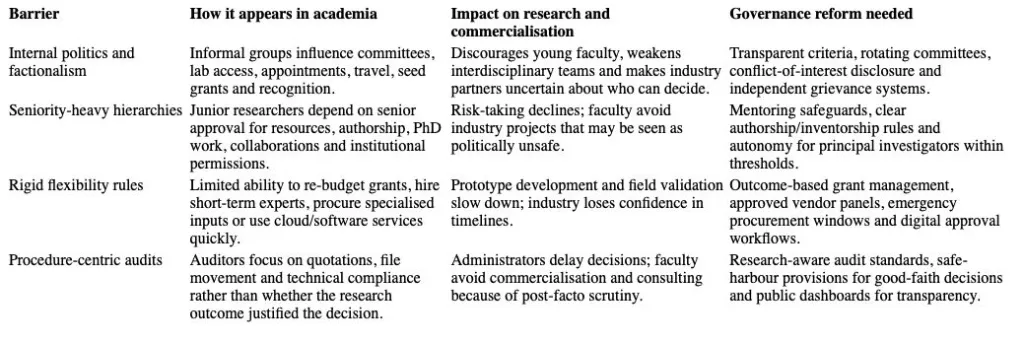
A less visible barrier to research translation is internal politics. Academia is built on peer review, collegial governance and disciplinary judgment, but in many institutions these ideals coexist with factionalism, patronage networks, seniority hierarchies, departmental gatekeeping and opaque control over laboratories, committees, appointments, PhD admissions, conference travel, research space and internal funding. Such politics is not unique to India, but it becomes especially damaging where formal systems are weak, grievance mechanisms are slow and career progression depends heavily on a small number of senior decision-makers.
Office politics can quietly distort commercialisation. A faculty member pursuing an industry project may be seen as too entrepreneurial, too close to a company, or insufficiently aligned with departmental priorities. A young researcher may avoid interdisciplinary or industry-facing work because it is riskier than publishing safely within a supervisor's network. Students may hesitate to disclose inventions if they fear disputes over authorship, inventorship, lab ownership or credit. Incubators and innovation cells may become ceremonial if access to resources depends more on proximity to power than on the quality of ideas.
The effect is cultural as much as administrative. When appointments, promotions, seed grants, laboratory access and committee roles are perceived as politicised, researchers spend energy managing relationships rather than building teams, filing patents, validating prototypes or engaging industry. Collaboration becomes fragile: companies want accountable counterparts and clear decision rights, while internal academic politics can make even simple decisions about ownership, credit, revenue sharing or student participation difficult.
Flexibility, Audit Culture and the Cost of Compliance
Research requires flexibility because discovery is uncertain. A grant may need to be re-budgeted after an experiment fails. A prototype may require an unplanned component. A clinical or field trial may reveal new validation requirements. A start-up collaboration may need fast access to software, cloud credits, testing facilities or contract staff. Yet many academic systems still operate as if research were a predictable administrative project with fixed line items, fixed vendors and fixed timelines.
Audit practices often intensify this rigidity. Audits are essential for public accountability, but when they focus narrowly on procedural compliance rather than research value, they can make institutions risk-averse. Administrators may ask whether a purchase will survive post-facto scrutiny rather than whether it is necessary for a scientific outcome. Principal investigators may under-spend or avoid industry partnerships because a later objection could damage their career. In such environments, flexibility is treated as a governance risk even when it is the condition for innovation.
The challenge is therefore not to weaken accountability but to modernise it. Research governance should distinguish between fraud, negligence and good-faith scientific uncertainty. Universities need rules that allow transparent re-budgeting, faster procurement for specialised inputs, accountable consulting, conflict-of-interest disclosure, inventor revenue sharing and time-bound approvals. Without this shift, India will continue to fund research projects whose commercial potential is lost in the gap between scientific ambition and administrative fear.
6. Global Models: What India Can Learn, and What It Should Not Copy Blindly
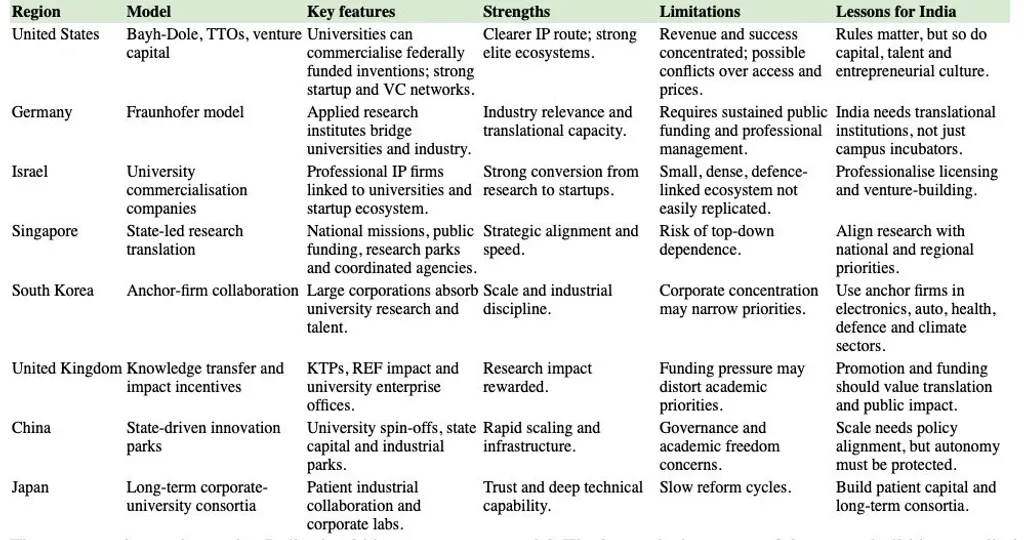
The common lesson is not that India should import any one model. The lesson is that successful systems build intermediaries. Fraunhofer is an intermediary. A technology transfer office is an intermediary. A research park is an intermediary. A university venture fund is an intermediary. A hospital-based med-tech validation centre is an intermediary. India’s gap is often not scientific talent; it is the absence of professional bridges between science and use.
7. India’s Structural Challenges
India’s R&D challenge begins with investment. Government data show that gross expenditure on R&D has increased in absolute terms but remained around 0.6-0.7 percent of GDP. This level is inadequate for a country seeking technological sovereignty in semiconductors, AI, pharmaceuticals, defence, energy, climate adaptation, agriculture and healthcare. The problem is compounded by the composition of spending: business participation in university-linked research is limited compared with many advanced innovation systems.
The second challenge is institutional inequality. The phrase “Indian academia” hides enormous differences. IIT Madras Research Park, IISc’s innovation ecosystem, select IISERs, top medical institutes and leading private universities operate in a different universe from many state universities and teaching-heavy colleges. Some institutions have doctoral programmes, research grants and industry offices. Others struggle with vacancies, outdated labs, heavy teaching loads and limited administrative capacity.
The third challenge is weak doctoral and postdoctoral pathways. India awards large numbers of science and engineering PhDs, but doctoral training is still too often disconnected from industry problems, regulatory pathways, product development and interdisciplinary teams. Postdoctoral culture remains thin compared with global research systems. Industry-funded PhDs exist but are not yet large enough to reshape incentives.
The fourth challenge is research management. Modern research requires grant managers, IP professionals, contract lawyers, lab managers, data stewards, ethics coordinators, regulatory experts and venture builders. Indian universities often expect faculty to manage these functions informally. This is inefficient and inequitable; faculty with social capital and administrative skill succeed, while others lose time to paperwork.
8. Kerala as a Regional Case: From Education Strength to Innovation Strength
Kerala is an important test case because it already has many ingredients of a knowledge economy: high literacy, strong health and education indicators, a large diaspora, digital public infrastructure, IT parks, public research institutions, universities, startup promotion and social demand for public-interest technologies. It also has constraints: limited large-scale manufacturing, brain drain, modest private R&D depth, fragmented research efforts and less venture capital density than Bengaluru, Hyderabad, Mumbai, Pune or Delhi-NCR.
Kerala Startup Mission has played a visible role in building entrepreneurial infrastructure, supporting thousands of startups, incubators and student innovators. Startup Genome has described Kerala’s ecosystem as having supported more than 8000+ startups, 60+ incubators, large funding facilitation and tens of thousands of jobs. Such numbers indicate ecosystem activation, but the deeper question is conversion: how many university inventions become licensable technologies, how many startups emerge from research labs, how many survive scale-up, how many patents are licensed, and how many public problems are solved?
Kerala’s institutional map is unusually rich. Digital University Kerala, APJ Abdul Kalam Technological University, K-DISC, KSCSTE, Kerala Knowledge Economy Mission, Maker Village, Technopark, Infopark, Cyberpark, Life Sciences Park, Bio 360, Sree Chitra Tirunal Institute, Rajiv Gandhi Centre for Biotechnology, CSIR-NIIST, IISER Thiruvananthapuram, CUSAT, University of Kerala, Mahatma Gandhi University, Kerala Agricultural University, Kerala Veterinary and Animal Sciences University and the Kerala University of Fisheries and Ocean Studies together span digital technology, health, biotech, materials, agriculture, fisheries, climate and applied science.

The state’s opportunity is not to imitate Bengaluru’s software scale or Hyderabad’s pharma-industrial depth. Kerala can build a distinct innovation model around med-tech, digital health, public health systems, marine technology, fisheries, food processing, Ayurveda evidence systems, climate adaptation, circular economy, tourism technology, assistive technology, ageing, education technology and knowledge services. Its hospitals, local governments, cooperatives and public agencies can become early adopters of validated technologies, creating a public-procurement route for innovation.
But this requires stronger commercialisation architecture. Kerala needs empowered technology transfer offices in universities and research institutes, a state-level IP and revenue-sharing framework, standard contracts, translational grants, shared testing facilities, diaspora mentorship, deep-tech scale-up capital and procurement pathways for technologies validated in Kerala. Without these, the state may produce many startups but too few research-led companies.
9. Public and Private Universities in India: A Balanced Comparison
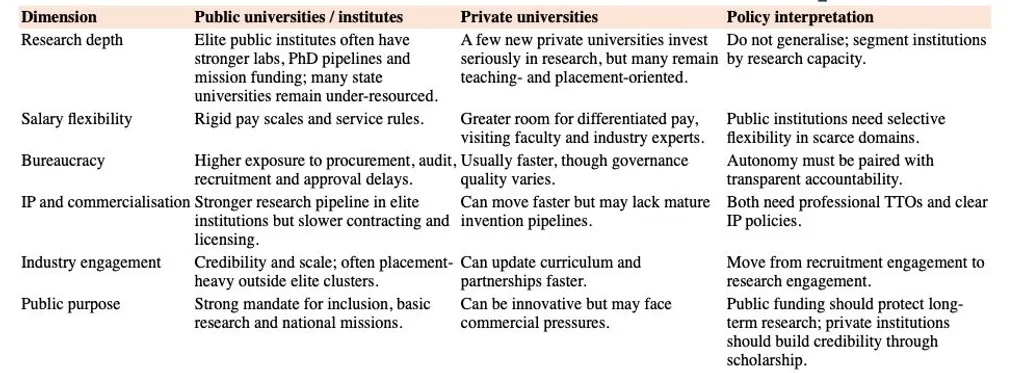
A mature policy approach should avoid two myths. The first myth is that public universities are inherently slow and private universities are inherently innovative. Some public institutions are India’s strongest engines of research; some private institutions are little more than teaching enterprises. The second myth is that flexibility alone creates excellence. Flexibility without research depth produces branding; research depth without flexibility produces unused knowledge. India needs both.
10. Case Studies
IIT Madras Research Park
IIT Madras Research Park is one of India’s most cited examples of a university-adjacent innovation platform. Its strength lies in proximity: companies, faculty, students and startups work near each other, making informal collaboration easier. The lesson is that physical infrastructure matters only when combined with faculty incentives, industry presence and institutional leadership.
Fraunhofer
Fraunhofer demonstrates that applied research can be institutionalised rather than left to individual faculty heroics. Its funding mix combines base funding, public projects and industry contracts. The lesson for India is to build professional translational institutes linked to universities and industrial clusters, especially in manufacturing, climate, health, agriculture and digital public infrastructure.
Bayh-Dole and US university technology transfer
Bayh-Dole did not magically create Silicon Valley, but it gave universities a clearer route to own and license federally funded inventions. Combined with venture capital, talent mobility and entrepreneurial norms, it helped create a technology transfer culture. India should learn the importance of clarity, not assume that copying legal text will replicate ecosystem outcomes.
Kerala Startup Mission and Maker Village
Kerala Startup Mission and Maker Village show how a state can activate entrepreneurship through infrastructure, student programmes, incubation and hardware support. The next step is deeper integration with universities and public labs: more research-led startups, patent support, prototype grants, testing facilities, industry mentors and public procurement pilots.
Sree Chitra Tirunal Institute and medical technology
Sree Chitra’s med-tech history illustrates Kerala’s potential in health innovation. Medical technology requires a combination of clinical insight, engineering, regulation, manufacturing and adoption. Kerala’s hospital networks and health system could become a living laboratory for validated, affordable medical technologies if contracting, procurement and regulatory pathways are strengthened.

Digital University Kerala
Digital University Kerala can become a bridge between advanced digital research and practical deployment in AI, cyber security, data science, electronics and digital governance. Its challenge is to link research to industry projects, government missions, startups and doctoral pathways rather than functioning only as another degree-granting institution.
11. Recommendations for India
For policymakers
Raise R&D intensity through public investment, matching grants and incentives for private-sector research in universities.
Create clear national IP commercialisation guidelines with inventor shares, student rights, publication windows and conflict-of-interest rules.
Fund professional technology transfer offices, research management offices and translational research centres.
Enable selective flexible compensation and market-linked research chairs in scarce domains such as AI, semiconductors, biotech, cyber security and climate technology.
Expand industry PhD, postdoctoral and faculty-in-residence programmes.
Reward patents, licences, standards, products, startups, public policy impact and social impact alongside publications.
Build regional innovation clusters around universities, hospitals, public labs, industry parks and startups.
For public universities
Delegate authority for sponsored research, consultancy, procurement and standard contracts.
Adopt transparent consulting, equity and conflict-of-interest policies.
Create internal seed funds and prototype grants.
Build professional TTOs and research management offices instead of relying only on faculty volunteers.
Reform promotion criteria to recognise translation, standards, public technologies and responsible commercialisation.
Enable joint appointments, professors of practice and industry sabbaticals.
For private universities
Invest beyond teaching into doctoral programmes, postdoctoral fellowships, labs and long-term research chairs.
Avoid reducing industry engagement to placements and branding.
Publish transparent IP policies and inventor revenue-sharing rules.
Partner with public research labs, hospitals and industrial clusters.
Hire research managers, patent professionals and venture builders.
Balance commercial sustainability with academic credibility.
For industry
Move beyond recruitment-driven campus engagement.
Fund long-term research chairs, shared labs and doctoral fellowships.
Co-create curricula without turning universities into narrow training centres.
Share risk in early-stage technology development.
Offer real problem statements, data access, testing sites and mentorship.
Build trust through multi-year partnerships rather than one-off MoUs.
12. Kerala: Building a Regional Innovation and Commercialisation Ecosystem
Create empowered technology transfer offices across major universities and research institutes, with shared legal and patent support for smaller institutions.
Develop a state-level university IP and commercialisation framework covering revenue sharing, faculty equity, student rights and public-interest licensing.
Link Kerala Startup Mission more deeply with Digital University Kerala, APJ Abdul Kalam Technological University, CUSAT, IISER Thiruvananthapuram, Sree Chitra, RGCB, CSIR-NIIST and sectoral universities.
Create translational research funds for med-tech, biotech, marine technology, climate resilience, AI, digital health, agriculture, food processing, Ayurveda evidence systems, tourism technology and circular economy.
Use Technopark, Infopark, Cyberpark, Life Sciences Park and Maker Village as industry anchors for university collaboration.
Mobilise diaspora capital, mentorship and global market access for university spin-offs.
Build shared prototyping, testing, certification and regulatory support facilities.
Make hospitals, local governments, cooperatives and public agencies early adopters of validated technologies.
Measure outcomes beyond startup counts: patents licensed, products commercialised, revenues, quality jobs, exports, public problems solved and research translated into practice.
13. Cutting Red Tape and Modernising University Governance
The most important governance reform is to replace permission culture with accountable autonomy. Universities should not be rule-free; they should be outcome-oriented, transparent and auditable in ways appropriate to research. A procurement delay that saves a small amount of money but destroys a research project is not good governance. A licensing system that prevents misuse but also prevents use is not public interest.
Create fast-track approval systems for sponsored research, consultancy, licensing, procurement and startup formation.
Use standard templates for MoUs, NDAs, sponsored research, IP licensing, material transfer, data sharing and revenue sharing.
Modernise procurement rules for specialised equipment, software, cloud computing, prototype components and lab services.
Delegate financial and contracting authority to principal investigators, departments, research centres and TTOs within clear thresholds.
Create safe-harbour rules so faculty and administrators are not punished for good-faith commercialisation decisions.
Reform audits to evaluate research outcomes, not only procedural compliance.
Allow flexible hiring of industry experts, professors of practice, research managers, patent professionals and venture builders.
Set time-bound approvals for research contracts, patents, ethics review, procurement and foreign collaborations.
Use digital dashboards to track sponsored research, patent filings, licensing revenue, startups, procurement timelines and contract delays.
Align UGC, AICTE, DST, DBT, CSIR, DPIIT, state governments and institutional rules to reduce regulatory fragmentation.
Create transparent internal governance rules for allocation of seed grants, lab space, doctoral admissions, travel support, innovation funds and incubator access.
Reduce the influence of informal academic politics by requiring conflict-of-interest disclosure in promotion, procurement, IP, incubation and sponsored-research decisions.
Protect early-career researchers and students through clear authorship, inventorship, grievance and anti-retaliation mechanisms.
Adopt research-aware audit standards that distinguish fraud from good-faith scientific uncertainty, failed experiments and justified commercial risk.
Permit transparent grant re-budgeting, faster hiring of project staff and flexible purchase of specialised research inputs within approved thresholds.
Evaluate departments and centres not only on compliance, but also on collaboration quality, technology transfer, student entrepreneurship, licensing, public impact and industry adoption.
14. Conclusion: Bridges, Not Merger
The industry–academia divide should not be erased. A country needs universities that ask questions the market has not yet priced, preserve intellectual freedom, train citizens and create public knowledge. It also needs companies that move quickly, create products, scale technologies and compete globally. The danger is not difference; the danger is isolation.
India’s innovation future depends on building bridges that are strong enough to carry people, ideas, money and IP in both directions. Salary reform matters, but so do autonomy and dignity. Patents matter, but so do products and public benefit. Incubators matter, but so do technology transfer offices, testing facilities, procurement pathways and patient capital. Public universities need freedom to act; private universities need depth to matter; industry needs to invest in research rather than only recruit from it.

Kerala shows both promise and warning. A state with high human development, strong education, health assets, digital ambition and diaspora networks can become a knowledge-driven innovation economy. But it will not happen through startup counts alone. It will happen when universities, research institutes, hospitals, industry parks, public agencies, startups and investors are connected through clear rules, professional intermediaries and outcome-focused governance.
The next generation of Indian universities must be more than places of instruction. They must become engines of discovery, translation, entrepreneurship and public problem-solving - institutions that can turn laboratories into livelihoods, ideas into industries and knowledge into national development.
Further readings
1. Government of India, Press Information Bureau. “R&D Investment in India,” 7 August 2025. Notes India’s GERD remained between 0.6% and 0.7% of GDP.
2.Department of Science and Technology, Research and Development Statistics at a Glance 2022-23. Reports India’s R&D expenditure at 0.64% of GDP in 2020-21 and provides comparative science indicators.
3. University Grants Commission / 7th CPC pay revision documents and university circulars, including professor Academic Level 14 rationalised entry pay of Rs. 1,44,200.
4. TeamLease, Jobs and Salaries Primer 2025; TeamLease Digital salary reports and related coverage on digital skills, GCCs and salary premiums.
5. Wheebox / ETS, India Skills Report 2025, and Government references to employability survey findings.
6. University of Pennsylvania Research Services, “Overview of the Bayh-Dole Act,” explaining university ownership and commercialisation obligations for federally funded inventions.
7. Association of American Universities, “Preserve the Bayh-Dole Act and University Technology Transfer,” 2024.
8. Fraunhofer-Gesellschaft, Annual Report 2024 and official finances pages describing contract research, industry revenue and the applied research model.
9. Kerala Startup Mission reports and official ecosystem pages, including annual and ecosystem reports.
10. Startup Genome, Kerala Startup Ecosystem profile, reporting ecosystem indicators such as supported startups, incubators, funding facilitation and jobs.
11. Official publications and institutional information from Digital University Kerala, APJ Abdul Kalam Technological University, K-DISC, KSCSTE, Technopark, Infopark, Cyberpark, Maker Village, Sree Chitra Tirunal Institute, RGCB, CSIR-NIIST, IISER Thiruvananthapuram, CUSAT and related Kerala institutions.
12. NITI Aayog and national consultations on Ease of Doing R&D, including discussions on research governance, administrative friction and reform priorities.
13. Ministry of Education / MHRD, Central University Vice-Chancellor recruitment advertisements, noting fixed VC pay of Rs 2,10,000 per month plus special allowance and usual allowances.
14. University Grants Commission and 7th CPC pay-revision circulars, including Professor Academic Level 14 entry pay of Rs 1,44,200 and Level 14 range up to Rs 2,18,200.
15. IIT Jodhpur faculty recruitment scale page, listing Professor basic pay of Rs 1,59,100 at Level 14A, Cell 1.
16. Deloitte India Executive Performance and Rewards Survey 2024, reporting average CEO compensation of about Rs 13.8 crore.
17. Reuters and Economic Times reporting on FY25/FY26 CEO remuneration at Infosys, HCLTech and TCS; company annual reports where available.
18. Infosys Integrated Annual Report 2024-25, Exhibit to the Board’s Report, disclosing gross remuneration for senior executives including the EVP and Chief Technology Officer.
19. ERI SalaryExpert and 6figr salary-survey pages for indicative private-university vice-chancellor and professor compensation; used as market signals where audited disclosures are unavailable.
20. Policybazaar and other CTO salary guides for indicative CTO market ranges in India; used with caution because CTO compensation varies widely by company scale, equity, sector and city.